
Decolonising Disability
How to create a space for disabled artists from the Global Majority to navigate their next steps in the industry. In collaboration with Bristol Old Vic.
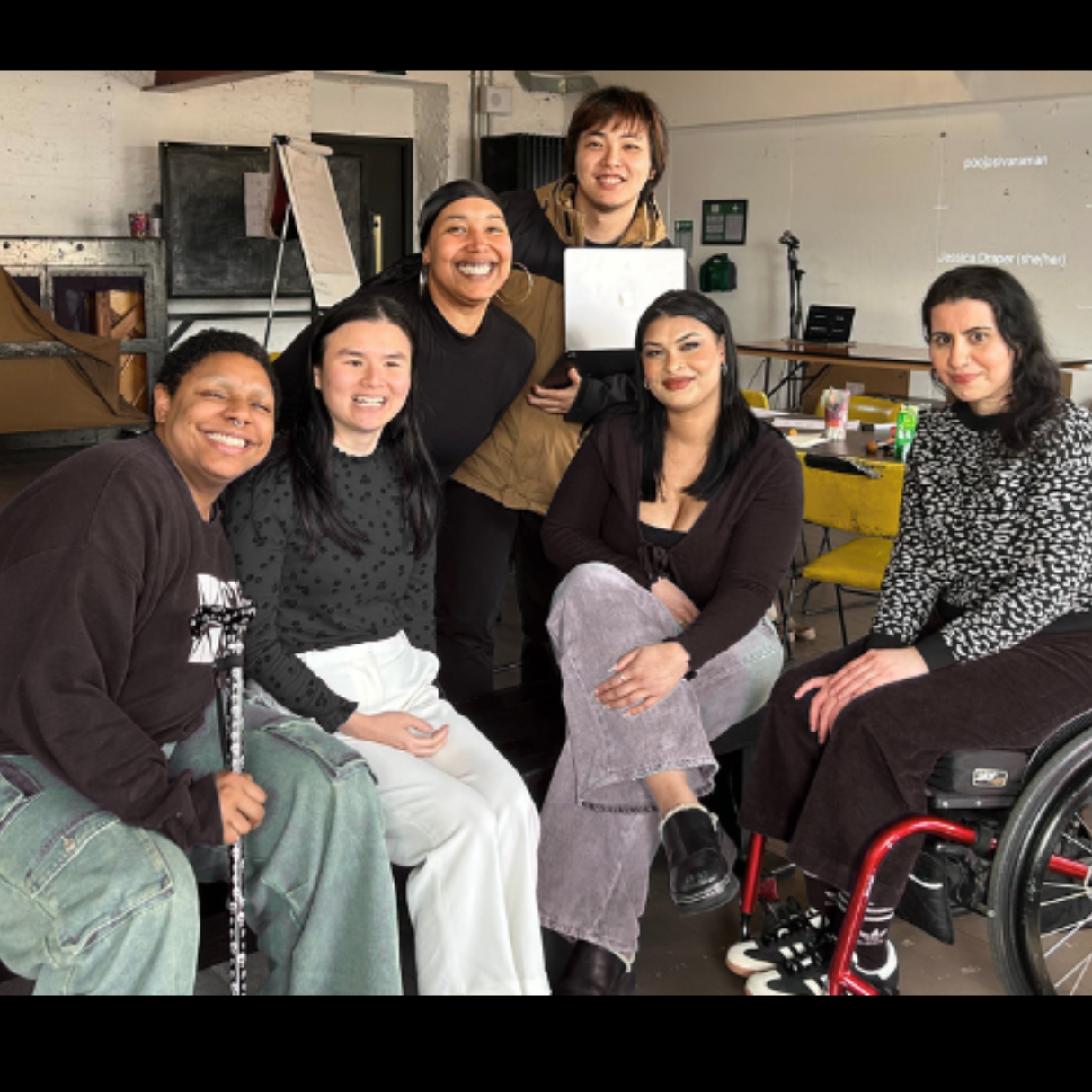
Photo from the third captioning Lab, with some of the participants and facilitators. From left to right: Eli Reina-Morris, Jasmine Thien, Koko Brown, Joey Qile He, Arielle Etheridge, Dalia Malek.
Contents (skip to section):
Decolonising Disability Lab Report
The Decolonising Disability was a 4-day long Lab that supported six disabled artists from the Global Majority. The Lab, in partnership with Bristol Old Vic, created a space for the artist to unpack their process of making work through a series of workshops delivered by Zuleika Lebow and Annabel Crowley, Independent Facilitators and Harris Albar from Tamasha Theatre.
The first two days welcomed the artists into the space, creating an environment of safety and openness. In a generous space artists and facilitators worked through a series of processes to support clarity in term of access and wellbeing, to focus in a more razor sharp way on art. This included processes of ‘unpacking’ of experiences of Global Majority and Disabled practitioners, followed by an opportunity to ‘fly’ or dream big. The second day focused on landing, making the journey of development tangible. One artist said of the first two days, “I’m going to take that workshop with me for the rest of my life.”
The final two days of the Lab focused on developing artistic practice and was led by Harris Albar. This offered the artists the opportunity to kick-start their artistic output and also opened up a conversation about how to connect effectively with the industry. Koko Brown a wellbeing facilitator supported the second two days.
The Lab was preceded by interviews with 8 disabled artists from the Global Majority, and extensive planning. The space was facilitated by artists from the Global Majority.
“I honestly believe that this Lab was a turning point for me and the other artists that were part of this residency. For me, it is a seminal point in my creative new life as an artists. Furthermore, with the learning that we had, it spurred me and the other artists to access, participate and be selected to be part of the most amazing opportunities and I honestly believe that this wouldn’t have happened, if it wasn’t the empowerment that we received during that residency.”
Rene Katiisa, VX Lab participant
Decolonising Disability Lab Report
We are delighted to share findings from our VX Lab on Decolonsing Disability which took place earlier this year in collaboration with Bristol Old Vic.
This report sheds light on how can disabled artists from the Global Majority be supported to bring their whole selves to their career.
Some of the key learnings: Intersectionality requires more than representation. Sometimes even the word ‘inclusion’ is not enough: systemic generosity is needed, not mere accommodation. Acknowledging colonial legacies and personal cultures that have been shaped in other countries is also incredibly important.
“For real change to happen, we need spaces designed with care, generosity, and cultural understanding at their heart. This Lab showed us what’s possible when disabled Global Majority artists are able to bring their whole selves to the room.”
Dr Mandy Precious, VX Labs Project Manager / Researcher
“We can’t keep retrofitting access or asking artists to fragment who they are. Disabled Global Majority artists are leading the way in showing us what inclusion really looks like, expansive, generous, and transformative.”
Josh Elliott, VX Artistic Director
This report and its recommendations provide essential reading for anybody interested in interrogating the way in which we work inclusively in addressing intersectional inequities across the industry.”
Ben Atterbury, Literary Manager, Bristol Old Vic
The report’s findings can be useful to both organisations and artists. Besides, for true change to come, these cannot be separated.
You can download the report below.
Acknowledgements
VX Labs is a three-year development programme that initiates new explorations of disabled-led practices, pursue disabled excellence and support intersectional practices within our sector, supported by research partner Royal Central School of Speech and Drama.
With thanks to Attenborough Arts Centre, Bristol Old Vic, Half Moon Theatre, Phizzical Productions, and Z-arts, for their support.
Read more about VX Labs and the findings from our national consultation in 2023.


